Mark 15:38—16:20
Ministries > Thru the Bible with Dr. J. Vernon McGee
https://www.oneplace.com/ministries/thru-the-bible-with-j-vernon-mcgee/
Facebook Twitter Instagram YouTubeJesus’ death was not the end, friends. Hear the testimonies of the people who believed—Pilate, the women, and the centurion. In this final study of Mark 15 and 16, discover why the resurrection is vital to our faith.
References
Steve Schwartz: How do we know that Jesus' death on the cross made a difference to God? What really changed? Well, those are important questions, aren't they? And we're going to find the answers today on Through the Bible. In this final study in the Gospel of Mark, we're going to witness a scene more dramatic than anything ever performed on a stage. The setting is Jerusalem. Three crosses stand along a road outside the city gates near a graveyard. It's a place of suffering and execution, a familiar site under Roman rule. And yet this day is unlike any other. Life in the city continues as usual. Business carries on. Worshipers gather at the temple. Then everything changes. Jesus surrenders his last breath and commits his spirit into his father's hands. The father accepts his sacrifice and history is forever altered. Our story changes as well, doesn't it? Inside the temple, in the Holy of Holies, God tears the great curtain from top to bottom. How do we know that this was God's work? Well, because no human could have done it. Scholars estimate that the veil stood at least 60 ft high and was 4 in thick. God himself opened what had always been closed. Through the sacrifice of the Lord Jesus Christ, that barrier between God and sinful humanity was removed. Access to the father was no longer restricted. The way was opened by God himself through his son. Isn't that a beautiful picture of the new relationship made possible because Jesus gave his life for us? Well, that remarkable lesson awaits us as we conclude our study of Mark. So let's pray. Father, thank you for accepting the sacrifice of your son on our behalf. Help us to grasp more fully what his death accomplished and what it costs. Deep in our gratitude for the grace and mercy that you have freely given us through Jesus Christ. We ask this in his precious name. Amen. We're off to Mark 15 and 16 on Through the Bible with Dr. J. Vernon McGee.
Dr. J. Vernon McGee: I did not conclude chapter 15 last time, not because it was such a long chapter. However, it was 47 verses, but not as long as the 14th, which was 72 verses. And we didn't finish it because we were dealing with the crucifixion of Christ, and I actually wish we'd had more time for that. But I want to put in now here at verse 38. We're told that when Jesus cried with a loud voice and gave up the ghost, and here now I'm reading, and the veil of the temple was rent in twain from the top to the bottom. Now this I think was evidently witnessed by many priests because it was 3 o'clock in the afternoon, and that was the time of the evening sacrifice. And they were serving in the temple at that very moment. And this certainly had some effect upon them. At any rate, we note later on that many of the priests came to a saving knowledge of Christ. For instance, I read Acts 6 7. And the word of God increased. And the number of the disciples multiplied in Jerusalem greatly. And a great company of the priests were obedient to the faith. Say under the quotation. And friends, this reveals that many of the priests believed on the Lord Jesus Christ. And we have every reason to believe that some of them were those that were serving in the temple at that time. Now the fact that the very moment that he gave up the ghost while the veil was rent in twain is not accidental by any means, and it's not given to us that way. Now when he gave up the ghost, then notice that's the way that he died. He didn't die because the bodily organs refused to function. He deliberately and definitely surrendered up his spirit. He could not die until he gave up his spirit. And he died differently, of course, than any of us. I've been in the presence of quite a few people that died. And these folk I've always noticed there's what is called a death rattle. And that means the last thing we do is we try to draw in our breath. That's the one thing we want. Is that final breath. He didn't do it. He dismissed his spirit. And that certainly made his death different in that sense. Now when he did that, at that very instant, the veil was rent in twain. Now that veil speaks of the humanity of Christ. We'll be going back to Leviticus and I'll be mentioning the tabernacle because the book of Leviticus has to do with the service in the tabernacle. And that veil, you'll recall, that speaks of the humanity of Christ and the message is tremendous. And it's this. You see the humanity of Christ or the life of Christ shuts us out from God. And the minute he died, the veil was rent. It's his death that brings us to God, not his life, friends. I have a book on the tabernacle in which I go into detail on that we offered it in Exodus, but you can order it at this time. It deals with this and the worship in the tabernacle and the articles of furniture and especially the veil. Now let me move on at verse 39. And when the centurion, which stood over against him, saw that he so cried out and gave up the ghost, he said truly this man was the son of God. I believe that this was the confession of faith of the centurion. And this is as far as he possibly could go at this time. He couldn't have said anything that would have revealed his faith more than this. He acknowledged that Jesus was God's son. He acknowledged who he was and certainly what he was doing. I do not believe that this man had all the details of theology. This man had never read Farnell's theology or Strong's theology. And he never read any of my books. But this man knew enough to take his place beneath the cross of Christ. And you know that's all God's ever asked any sinner to do, to come in faith to him. And that's all this man's doing. And you must remember he was a pagan Roman and he had the cruel job of crucifying man. And certainly he's made very tender this time. Now we're told that there were these women that were present. It's interesting to note the women were the last at the cross and the first at the tomb, by the way. And these stood afar off. They remained faithful. They were the ones that were faithful to the very end. His disciples and apostles, they were scattered at this time. Now there are other women, of course, that are not named here at all. It says in many other women which came up with him under Jerusalem. Verse 42. And now when the even was come, because it was the preparation, that is the day before the Sabbath, Joseph of Arimathea, an honorable counselor, which also waited for the kingdom of God came and went in boldly under Pilate and craved the body of Jesus. And Pilate marveled if he were already dead. And calling unto him the centurion, he asked him whether he'd been any while dead. And when he knew of the centurion, he gave the body to Joseph. Now this is something that's quite interesting to note in just passing over this. Joseph of Arimathea was a little known follower of Jesus. He actually had charge of the burial. And he had the courage to step out in the open here. He was a member of the Sanhedrin. And this man had not consented to the council and deed of them. And he was of Arimathea, a city of that land. He also was waiting for the kingdom of God. And this man now steps out as a follower of the Lord Jesus when the apostles are scattered, gone undercover, and he begged the body of Jesus. Now we are told here that Pilate marveled that he was so soon dead. And the reason is that customarily a person who is crucified would linger alive on a cross sometimes for days. His life just gradually expired. It was a cruel and inhuman mode of torture. And this is the reason that Pilate marveled that Jesus was already dead and he made special inquiry. Jesus gave up the ghost. This is important to see. And in the last hours of dying, a prisoner on the cross had his legs broken to hasten his death. But Jesus was already dead and it was not necessary to break his legs. And then you know that was a fulfillment of prophecy and not a bone of his body would be broken. Now Pilate, we're told, gave the body to Joseph. And it's interesting to note that there are two words used for the body in this connection. Joseph asked for the body. That's the soma. And Pilate gave him the ptoma. And that's another Greek word. The first speaks of the total personality and it's a word of care and tenderness. But the word used when Pilate gave the body just means the corpse or a carcass, you see. It's a different viewpoint and attitude toward death and toward the bodies of those that are dead. The word that when Joseph went in, he asked for the body, but it was a word of tenderness. He wanted Jesus. And all Pilate did, he just gave him a carcass. What a difference it is. Only the Lord Jesus, friends, can put any value on you. You're not worth very much. And he paid a tremendous price for our redemption. And even our bodies are to be redeemed and we groan within these bodies, but there's a day coming when our bodies will be redeemed. This is just a little insight here. Now will you notice Joseph is called here a rich man. And he put away the body tenderly in his new tomb and he rolled a stone there. And he bought the fine linen, took him down, wrapped him in the linen, laid him in a sepulcher that was hewn out of a rock, rolled a stone unto the door of the sepulcher. Now that door was sealed. That rock was sealed by the Roman soldiers later on. And he was the one that rolled the stone there. And the soldiers sealed it. And the only mourners there were the women. They were with him to the very very end. God bless the women. Notice verse 47 and Mary Magdalene, Mary the mother of Jesus, beheld where he was laid. Now in chapter 16 we come to the resurrection and the ascension of Jesus. And the bodily resurrection of Jesus is one of the cardinal doctrines of the Christian faith. It's the very heart of the primitive gospel. Every sermon preached in the book of Acts is a message on the resurrection. Every speaker got to this subject. And the early church dwelt upon it constantly. And unfortunately, we only have one Easter sermon a year. He's arisen. That's the thrilling message which electrified a lethargic and sinful generation in the Roman Empire. Turned them upside down, wrong side out and right side up. And they went out to tell the world about it. There'd be hope today if the church would preach this truth with much assurance. Let me tell you. Now I want you to notice here that this chapter has been one under severe criticism by the higher critics. And very candidly, rightly so. And the only reason I'm going to mention this is because of the fact that there'll be some will say well done. We know the textual problem that is here because he's passing over it. Well, I'll say to you I know that it's here. From verses 9 through 20 have been called and questioned by the textual scholars of both the conservative and the liberal groups. Westcott and Hort, for instance, they omit it from their Greek texts. They do include it in smaller type and Nestle follows the same procedure by separating it from the regular texts. And some, of course, the liberal wing omits it all together. Now the better manuscripts omitted entirely. And frankly, the manuscript Aleph, which is one of our best, and the Vatican manuscripts, they end Mark's gospel at verse 8 of chapter 16. Now I'm not going into this problem of New Testament introduction. That's not our purpose in studying the Bible like this. I call attention to it just for one reason, to let you know we know it's there in order that I might say that I treat all of the chapter 16 as the word of God. Now without any further ado, let's move into this chapter. We have first the arrival of the women at the empty tomb in the first four verses. Then the announcement of the angel that Jesus had risen, verses 5 through 8. Then the appearances of Jesus, verse 9 through 18. And then the ascension of Jesus, verses 19 to 20. We'll hit high points here. And when the Sabbath was past, that is now the first day of the week, Mary Magdalene and Mary the mother of James and Salome had bought sweet spices that they might come and anoint him. They never were able to anoint him, I'll tell you. It was not Mary of Bethany who wasted her ointment. It's these women that died because he was risen. And very early in the morning, the first day of the week, they came unto the sepulcher at the rising of the sun. And they said among themselves, who shall roll us away the stone from the door of the sepulcher? And when they looked, they saw that the stone was rolled away for it was very great. Now the Sabbath had ended at sundown on Saturday. And they secured the spices sometime after that in order to make the trip to the tomb so early on Sunday morning. And the same women who were present at the cross came to the tomb. And I think it's accurate to state that the women were the last at the cross and the first at the tomb. The attitude of the disciples was that he was dead. And it's better to stay undercover until after all the excitement had died down and they were no longer in danger. Did they intend to go to the tomb? There's no evidence to support such an intention. None of them intended to visit that tomb. Now it was very early at sunrise. And these women intended to anoint the body of Jesus with the spices they'd bought. And they were presented with the difficulty of getting into the tomb because of the stone at the door. Now their difficulty was dissolved by the fact that the stone was rolled away. The body of Jesus was gone. That was a heavenly message with the first announcement of the resurrection. That the tomb was empty is a fact that's well attested and established. The evidence is such that it would be acceptable in a court of law. Listen now as I read. And entering into the sepulcher, they saw a young man sitting on the right side clothed in a long white garment. And they were affrighted. He saith unto them, be not affrighted. Ye seek Jesus of Nazareth, which was crucified. He's risen. He's not here. Behold the place where they laid him. He was not there. That was obvious. Now notice verse 7, but go your way. Tell his disciples and Peter that he goeth before you into Galilee. There shall ye see him as he said unto you. Now will you notice that the fact of the empty tomb and we need to put the four gospels together. Back in Matthew we went over that. We'll go over it again when we get to John's gospel, by the way. But all I want to do here is to quote the statement of Lord Linthurst, who was high chancellor of Great Britain back in 18 46. And he was also the high steward of Cambridge, the highest honor that they give. And he made this statement. He says I know pretty well what evidence is. And I tell you such evidence as that for the resurrection has never broken down yet. Now the women here are told now to go and report. Verse 7. But go your way. Tell his disciples and Peter that he goeth before you into Galilee. There shall ye see him as he said under you. Now the women are to report to the disciples. The angel was surely not waiting for some disciple to come by, as you can see, because he sends a message to them. He'll meet them in Galilee as he promised. And John 21 gives that remarkable episode which we're to look at later on in this study. Now you can well imagine the amazement of these women. They were speechless. And this frankly doesn't seem to me to be an appropriate place for Mark to end his gospel. And they went out quickly, fled from the sepulcher. For they trembled and were amazed. Neither said they anything to any man, for they were afraid. Now this part is the part that is not in the better manuscripts, yet we believe it belongs in the word of God. Now let me move rather hurriedly. Now when Jesus was risen early the first day of the week, he appeared first to Mary Magdalene, out of whom he'd cast seven demons. Now you see Mark has made it clear to us he wasn't giving us the chronological order. What he's saying now is that this is the order. Mary Magdalene first. She went and told them that had been with him as they mourned and wept. And they, when they had heard that he was alive and had been seen of her, believed not. They did not believe Mary Magdalene at all. After that he appeared in another form unto two of them as they walked and went into the country. Now Dr. Luke gives us that walk on the Emmaus road. They went and told it unto the residue. Neither believed they them. Afterward he appeared unto the eleven as they sat at meat and upbraided them with their unbelief and hardness of heart because they believed not them which had seen him after he was risen. Now you see we have Mark giving us more or less an order of the events after the resurrection. He said unto them, go ye into all the world, preach the gospel to every creature. This has been a gospel of action. Now he's telling them to get into action. They are to go. And by the way, he's saying to us today that we should be men and women of action for God. What are we doing today to get the word of God out? That's our business, friends. You ought to have some part in getting the word of God out. Now he says, he that believeth and is baptized shall be saved, but he that believeth not shall be damned. And he doesn't say that if you're not baptized, you'll be damned. You notice that. That's not essential. I'm not going into details here. And these signs shall follow them that believe. In my name shall they cast out demons. They shall speak with new tongues. They shall take up serpents. And if they drink any deadly thing, it shall not hurt them. And they shall lay hands on the sick and they shall recover. And if you want to accept any one of these sign gifts, then take them all, my brother. And I have a formaldehyde cocktail that I'll be glad to prepare for you if you think you could do it. May I say to you these were sign gifts at the beginning. And it's important to see that. These signs shall follow them that believe. Now the evidence today is he that doesn't have this doctrine, it's the word of God today. That's the great sign in this hour. So then after the Lord had spoken under them, he was received up into heaven, sat on the right hand of God. And they went forth and preached everywhere, the Lord working with them and confirming the word with signs following. That was for the apostles, friends, because that's what we're dealing with here. And I've had to deal with this very quickly and actually so briefly. I wish even in a five-year course we could spend more time in many of these places, but we must move on. We go back to Leviticus, the Old Testament. Next time be with us, friends. May God richly bless you, my beloved.
Steve Schwartz: Well, wasn't that a great study in the Gospel of Mark? You can revisit these studies anytime by downloading our app or listening online at ttb.org. One listener, Horace, wrote us to tell us this. This program is a source of bread that sustains me. It lifts me up spiritually and propels me by reinforcing my spiritual energy. It gets me through each day. If someone you know could use that same strength and hope, why don't you invite him to hop aboard the Bible bus with you? And we'd be happy to send you a pack of Bible bus passes if you want to share them with friends and family or people in your church or just people you meet along the way. Just call 1-800-65 Bible and we'll get them out to you. And to go a little deeper in Mark, well, be sure to download our free Bible companion from our app or at ttb.org. I really love these. Along with a synopsis of each study, you're going to find links to Dr. McGee's messages, the scripture passages, and discussion questions that make it perfect for a personal study that maybe you alone or your family or a small group can go through or a Sunday school class. Also over at ttb.org you'll find the digital booklet Dr. McGee mentioned, The Tabernacle, God's Portrait of Christ. Next time we'll head back to the Old Testament as we begin our study of Leviticus. If you think Leviticus is outdated and boring, well, just wait until you hear Dr. McGee open it up. To get the notes and outlines for Leviticus, you can visit ttb.org to download our digital book, Briefing the Bible, or call 1-800-65 Bible to request a printed copy. And we'd love to hear from you, too. Tell us how God's using his word in your life or how you listen to Through the Bible. Your letters and emails, they really do mean so much to our team. And they often get shared to remind listeners from around the world that God is at work in people's lives. Just call us at 1-800-65 Bible or write to us at box 7100, Pasadena, California 91109. In Canada, box 25325, London, Ontario N6C 6B1. Or send an email to biblebus at ttb.org. I'm Steve Schwartz, grateful to be traveling through the Bible with you.
Guest (Male): We're grateful for the faithful and generous support of Through the Bible's partners whom God uses to take the whole word to the whole world.
Related Episodes
About Thru the Bible
Thru the Bible takes the listener through the entire Bible in just five years, threading back and forth between the Old and New Testaments. You can begin the study at any time. When we have concluded Revelation, we will start over again in Genesis, so if you are with us for five years you will not miss any part of the Bible.
Other Thru the Bible Programs:
Thru the Bible - Minute with McGee
Thru the Bible - Questions & Answers
Thru the Bible - Sunday Sermon
About Dr. J. Vernon McGee
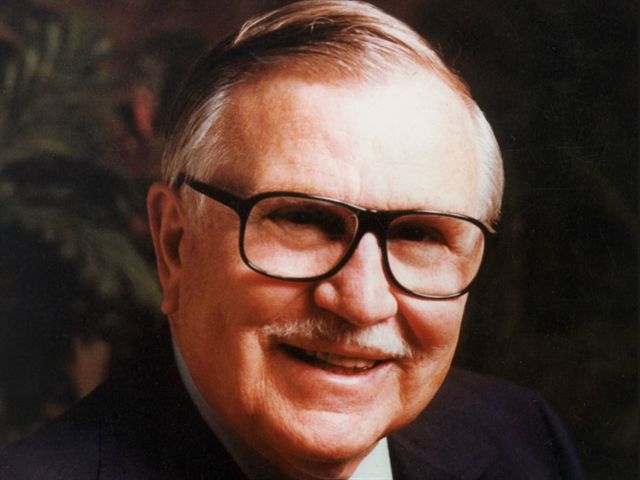
John Vernon McGeewas born in Hillsboro, Texas, in 1904. Dr. McGee remarked, "When I was born and the doctor gave me the customary whack, my mother said that I let out a yell that could be heard on all four borders of Texas!" His Creator well knew that he would need a powerful voice to deliver a powerful message.
After completing his education (including a Th.M. and Th.D. from Dallas Theological Seminary), he and his wife came west, settling in Pasadena, California. Dr. McGee's greatest pastorate was at the historic Church of the Open Door in downtown Los Angeles, where he served from 1949 to 1970.
He began teaching Thru the Bible in 1967. After retiring from the pastorate, he set up radio headquarters in Pasadena, and the radio ministry expanded rapidly. Listeners never seem to tire of Dr. J. Vernon McGee's unique brand of rubber-meets-the-road teaching, or his passion for teaching the whole Word of God.
On the morning of December 1, 1988, Dr. McGee fell asleep in his chair and quietly passed into the presence of his Savior.
Contact Thru the Bible with Dr. J. Vernon McGee
Mailing Address
Thru the Bible, Inc.
P.O. Box 7100
Pasadena, CA 91109
In Canada:
Box 25325,
London, Ontario
N6C 6B1
Phone Number
(626) 795-4145 or
(800) 65-BIBLE (24253)


