Exodus 25:23—26:14
Ministries > Thru the Bible with Dr. J. Vernon McGee
https://www.oneplace.com/ministries/thru-the-bible-with-j-vernon-mcgee/
Facebook Twitter Instagram YouTubeHow can furniture be Holy? From ceiling to floor, every piece of furniture in the Tabernacle pointed to Christ. Discover how each piece symbolizes a specific characteristic of God and His perfect plan of redemption through Jesus Christ.
References
Host: Most of us would rather walk through a finished home than stare at a set of blueprints. After all, the beauty isn't seeing how every measurement and line comes together into something remarkable. Welcome to Thru the Bible. As we step into God's blueprint for the tabernacle, now at first glance, these chapters may seem filled with tedious details. But look a little closer and you'll discover something extraordinary. One of Dr. McGee's favorite studies reveals how every small part of this desert sanctuary points beyond itself to the loveliness and glory of Jesus Christ. As we turn to Exodus 25, let's begin by hearing from some of our fellow Bible bus passengers. First, we got a note, this is from Bill.
Host: Greetings to all from Ohio. My wife Polly and I moved to our new home back in October of 2025. Our main reason for moving here was to get closer to our two young grandsons, who are two and a half years old and five months old. They have been a great blessing to our family. I remember Dr. McGee talking about his grandson and how he loved to spoil him. They definitely tug on your heartstrings. In March of this year, 2026, I retired after 42 years of working in a chemical lab. This program has always been a major part of my career. Although a longtime bus rider, listening every day of the week, I continue to be blessed by all the programs, five-year study, Q&A, and Sunday sermon. It's been a daily priority ingrained in my spiritual life and my relationship with my savior, the Lord Jesus Christ. My church just finished a 17-week series called Threads. Its purpose was to connect the Old Testament to the New Testament. It was like a refresher course on everything I learned while riding the Bible bus. The Holy Spirit reinforced the importance of the whole word of God to me, especially regarding the tabernacle and the truth that God's presence is always with us. Thank you so much for your faithfulness in teaching the whole word of God in truth and hope. I encourage all my fellow Bible bus riders, my brothers and sisters in the Lord, and those seeking the truth of God's love to continue riding the Bible bus and receiving the spiritual blessings found in his precious word.
Host: Well, that's a great letter, and I'll keep saving you a seat, Bill and Polly. And then here's a note from Sandra, and she writes,
Host: I'm on my second journey through the Bible. Although I had been a Christian for many years, I had no idea how the Bible is one book and the aching in my heart for more of God's word and his presence is new to me as of the last five years. I just turned 82. I want everyone to hear and believe in Christ. I love you, Steve, Greg, and Dr. McGee, and all my family in the Lord. I will spend all eternity thanking our savior for his mercy and grace and forgiveness. I am like the woman weeping at Jesus' feet. Words have little ability to express what I mean.
Host: Thank you all and to all who listen, I am so looking forward to seeing you all in heaven.
Host: Well, Sandra, thank you so much and I love your enthusiasm even at 82. You know, we're never too young or too old for the Lord to work in our hearts and draw us closer to himself. How's God working in your life as we study his word together? You know that we'd love to hear from you. Is he calling you to spend more time in his presence? Is he maybe challenging you to share his word with others? Why don't you send us a note through our app? That's so easy. You can also email us at [email protected] or write to us at Box 7100, Pasadena, California, 91109. In Canada, the address is Box 25325, London, Ontario, N6C 6B1. You can also call and leave a message anytime at 1-800-65-BIBLE. Let's pray. Heavenly Father, thank you for giving us your word and for revealing yourself through every page of scripture. Lord, as we study the Tabernacle, help us to see beyond the details to the beauty and the glory of your son Jesus Christ, in whose name we pray. Amen.
Host: Here's Dr. J. Vernon McGee with our study of Exodus 25 on Thru the Bible.
Dr. J. Vernon McGee: Now we come to the table of showbread, and there are seven articles of furniture in the tabernacle. You find out where they're placed, it'll sure be helpful. There were three sections or compartments of the tabernacle. We are moving as the Bible moves from the inside where God was. The tabernacle proper was 30 cubits by 10 cubits by 10 cubits. And that was divided into two compartments, the Holy of Holies, 10 x 10 x 10, and in it it had the ark and the mercy seat. We saw that last time. That mercy seat with the cherubim overshadowing it, it is the most ornate part of the tabernacle. There's no idol in there at all. These two cherubim look down upon the top where the blood was placed. Did you know that was the same thing Adam and Eve saw when they looked back at the Garden of Eden when God put them out? They looked back and they saw cherubim keeping the way of life. They saw the blood of the animals. They were wearing the skins and the cherubim were looking down. That kept the way of life open. God wasn't blocking them from coming into the Garden of Eden. He was keeping the way open for them to himself. And when Moses made this, it was a replica of the same thing Adam and Eve had seen. Now it looks into the future. It speaks of the fact that Christ today has made a mercy seat for us. That is the throne of God has become a mercy seat. He died down here, took his blood up there and the throne of God today is a place where a holy God can extend mercy to you and to me. Then when you come into the outer court here, which is the tabernacle proper, the holy place. It has three articles of furniture, the altar of incense, the golden altar, and then the golden lamp stand, and the table of showbread. And this was a place of worship. It speaks of worship of God. It's very important. Then in the outer court, you have two articles of furniture, a laver and a brazen altar. And here's where the sin question was settled. These two articles of furniture speak of Christ as he settled the sin question. In the holy place it's worship. The sin question has to be settled before you can worship God. Now we have the instructions here for the table of showbread. And it's showbread because the table had on it loaves of bread. And they were arranged in two rows of six each. Now there are different explanations of just how they were arranged, and I must confess I can't tell from reading this just how they were. I just feel like it was very simple. There were two rows on top of the table, six in this row, six in that row. And each speaking of a tribe of Israel. In other words, God was providing equally for all. Now will you notice, I'm reading, thou shalt also make a table of shittim wood. Two cubits shall be the length thereof, and a cubit the breadth thereof, and a cubit and a half the height thereof. Now you'll notice that the table of showbread, it's two cubits long, and it is a cubit wide, twice as long as it is wide, and a cubit and a half the height thereof. It's the same height as the mercy seat, or the ark. And thou shalt overlay it with pure gold, and make thereto a crown of gold roundabout. That is a border or a sort of a side border around the table, keep the bread, of course, from falling off. Verse 25, and thou shalt make unto it a border of a handbreadth roundabout, and thou shalt make a golden crown to the border thereof roundabout. And thou shalt make for it four rings of gold, and put the rings in the four corners that are on the four feet thereof. And again, this was staves were to be put through these rings and on the wilderness march it was carried on the shoulders of priests. Now I turn over and read verse 29, and thou shalt make the dishes thereof, and spoons thereof, and covers thereof, and bowls thereof, to cover with all of pure gold shalt thou make them. And thou shalt set upon the table showbread before me always. Now the bread, of course, was a type of Christ, and therefore the table is a type of Christ. It's a picture of him. And this table of showbread is that which suggests many things. I think that it speaks of sustenance. It speaks of provision. It speaks of supply. And I want to make several suggestions, and will you notice them? It's a table of salvation. Now Christ gave a parable. Do you remember in which a king gave a marriage supper for his son. The invited guests refused to come and this provoked the king to deal with the rejecters, and having done so, he extended the invitation to include those in the highways and byways. And these were bidden to come and to eat. Thus, an invitation has gone out today to the world to come and to partake of the salvation as it is in Christ. And secondly, it's a table of providence. I don't have time to develop this, but God as a creator provides all food for man and beasts today. Whether you like it or not, friend, you eat at God's table in the physical realm. And yet how few recognize it today and give thanks to him for his bounty. God is the one who provides for us. And this table also speaks of the table of the Lord, the Lord's supper. This suggests the one that our Lord, you remember in the upper room established. It's the table for believers. It's a long table, extending from the upper room to the upper air. And then, more specifically, I think the table of showbread is a prefigurement of Christ as the sustainer of spiritual life for the believer. It was two cubits long, one cubit wide, one and a half cubits high, made of shittim wood, overlaid with gold. The incorruptible shittim wood speaks of his humanity. And as the wood was a product of the earth but not subject to the action of it in a chemical way, thus our Lord had a body made of earth, conceived in the womb of the virgin, and the gold speaks of his deity. The gold is not produced by the earth but is separate from it. And because of that, it has an inherent value. So Christ was not of the earth in his deity, but he was very God of very God. He came from glory. And so the figure of the gold and wood, we have already seen was further amplified when the ark was looked at last time. Now on the table there were placed these 12 loaves of bread, six in a row. And the table and the bread were just called one. In fact, we have that metonymy of speech today, to eat the table of the Lord. Well, you don't eat the table, but that's the way we use it. We associate the table with the food. Eat at my table. Well, gracious, what are you going to do? Chew on a leg of the table? No. The table and the bread are considered one. Now the bread was changed each Sabbath, and the bread which was removed was eaten with wine by the priestly family in the holy place. And this table, I want to say this, does not prefigure Christ in the same way that the manna does. And we need to be very careful here. I think both speak of Christ, but not in exactly the same connection, although Christ is the bread in both. Now the manna speaks of Christ as the life giver. He interpreted it himself. You remember in John 6:32, we've already seen that. Then Jesus said unto them, verily, verily, I say unto you, Moses gave you not that bread from heaven, but my Father giveth you the true bread from heaven. For the bread of God is he which cometh down from heaven, and giveth life to the world. I'm the bread of life. He that cometh to me shall never hunger. He that believeth on me shall never thirst. Now the showbread speaks of Christ as the life sustainer. Eternal life is a gift, and is the manna that came down from heaven. He that receives the manna receives eternal life. However, eternal life requires a special food to sustain it in growth and strength. And the showbread sets forth Christ as the food for those who have partaken of the manna of life. He's seen in another bit of language that he himself used. The showbread was made of grain. It was ground unleavened and made into bread and baked. It's first stated in Leviticus, thou shalt take fine flour, bake 12 cakes thereof, two tenths deals shall be in one cake. And we find that the Lord Jesus said, verily, verily, I say unto you, except a corn of wheat fall into the ground and die, it abideth alone. But if it die, it bringeth forth much fruit. Now, he was ground in the mill of suffering. Now is my soul troubled. What shall I say? Father, save me from this hour? But for this cause came I unto this hour. He was brought into the fire of suffering and judgment. Now is the judgment of this world. Now shall the prince of the world be cast out, and I, if I be lifted up from the earth, will draw all men unto me. He came forth from the tomb in newness of life. For his soul did not see corruption. Now he lives a resurrection life. He is the showbread now for believers to feed on, to sustain eternal life and growth. The Christian is to feed on the living Christ. He's to appropriate Christ as he is today, living at God's right hand. He said, I'm the bread of life. There's an ancient proverb that contains the thought that a thing grows by what it feeds on. And there was a book that came out for dieting not too long ago and it said you are what you eat. And the difficulty today is that we've got too many Christians that are not feeding on Christ. You have to feed on him to grow. And you feed upon him as he is today. Paul said, though we knew him in the flesh, we know him no longer after the flesh. He is today the living Christ. And we're to grow by looking to him. Now that's the meaning here of that. Now we come to the lamp stand here, and that instruction is given in verse 31. Our translation calls it candlestick. Really it was a lamp stand. And thou shalt make a candlestick or lamp stand of pure gold. A beaten work shall the lamp stand be made, his shaft and his branches, his bowls, his knops, his flowers shall be of the same. And six branches shall come out of the sides of it. Three branches of the lamp stand out of the one side, three branches of the lamp stand out of the other side. Three bowls made like unto almonds with a knop and a flower in one branch and so on. Now I think I can describe this because this becomes rather tedious in reading it. Verse 40, and look that thou make them after their pattern which was showed thee in the mount. Now the lamp stand was, I suppose, the most perfect picture that we have of Christ of anything in the tabernacle. I think this sets him forth, and of course it was a pure gold and it speaks of his deity. It sets him forth as he is God. Now worship has to do with walking in the light. That's important to see. We saw the table of showbread. Well, that table of showbread speaks of the fact that when you worship God, you must feed on Christ. That's what it means. If you go to church and you're being entertained and being given a book review or you're talking about some social issue today or how to improve Los Angeles, my friend, that's not worshipping God. You're just having a meeting. You only worship God when you feed upon him who is the table of showbread, but you must walk in the light and he is the light, by the way. And if you wanted natural light, you had to go outside of the tabernacle. If you want to walk in the light of the lamp stand, you had to go inside. He's the true light that lighteth every man that cometh into the world. And you find that there are those that darkeneth counsel by words today. And we are told that through philosophy and vain deceit we can be deceived. God is light, though, and in him is no darkness at all. And the lamp stand was actually made of one piece of gold. It was beaten work and highly ornamented. It had a central shaft, but out from that central shaft there were three branches on a side, making seven branches in all. And each branch was like a limb of an almond tree. That is, it had on it a blossom and fruit and at the top was an open blossom, and in that the lamps were placed. The lamps were filled with oil and put in there. And on top therefore of each shaft there was an open almond blossom, and in each of these was placed the olive oil lamps. Now the almond blossoms looked like wood but they were gold. And that reminds us of Aaron's rod that budded. When Aaron's priestly prerogative was in question, the budding of his almond rod established it. Now the almond rod, a dead branch, was made to live and bear fruit. Christ was established as the Son of God by his resurrection from the dead. It didn't make him the Son of God, for he was already that from the eternal counsels of God. Resurrection only confirmed it. Aaron was the God-appointed high priest, and it was confirmed by resurrection in the dead almond rod. The resurrection of Christ likewise established his priesthood. Christ is our great high priest, and he became a man, he partook of our nature, tempted in all points as we are, sin apart. But the primary basis of his priesthood is his deity. You see, the priest represented man before God and Christ as God who became a man. And he's now the God-man who represents man. Somebody up there that knows me and understands me and is able to help me. The resurrection which declared him to be the Son of God, likewise declared his priesthood. And the thing that's interesting to me, there was no measurements given here of the lamp stand. I wonder if you noticed that. Well, why? Because you can't put a yard stick down on deity, friends. You can't measure him as the Son of God, and you can't understand him at all. But also there is his humanity. And along with the fact that Jesus wept, he also said, Lazarus, come forth, and Lazarus came forth. And the lamp stand gave light in the holy place. It's the place of worship. And the very interesting thing about it, the lamp stand held up the lights, the lamps. But they in turn revealed the beauty of the lamp stand. Now the light there, the oil and the light up above there, that represents the Holy Spirit. And the Lord Jesus says if I send him into the world, and he sent him into the world. Why, he says he'll take the things of mine and show them unto you. And when you and I gather together for worship, or here on the radio like this, and there's some of you riding along in an automobile, there's some of you at home, there's some of you that are in many, many places. It's hard for me to identify where you are right now, but altogether we are meeting around the person of Christ. And he's beautiful. He's lovely. He's wonderful. And he's God. And the Holy Spirit now will take the things of Christ and show them unto us just as those lamps revealed the beauty of the lamp stand. Reveals him as the Son of God, the one who came on our behalf and who lives up yonder for us just now. Now will you notice that we come now to chapter 26, and we have here the curtains of linen. And I want to say just a word concerning them. The tabernacle proper had over it three coverings. It had a linen covering. Well, it had four coverings actually. It had first that linen covering that was put all over the tabernacle proper. Now that's the part that was 30 cubits long, 10 cubits wide, 10 cubits high. Now this linen cloth as it was sewed together came up over all of that part, and it came down the sides and didn't quite touch the ground. It was not permitted to touch the ground. Now the next one was a goat's hair covering. And we're told here, the linen is given, well, let me read this. Verse one of chapter 26. Moreover, thou shalt make the tabernacle with 10 curtains of fine twined linen, and blue, and purple, and scarlet with cherubim of cunning work shalt thou make them.
Related Episodes
Exodus 25:10-22
Wednesday, September 30
Exodus 24:1—25:9
Tuesday, September 29
Exodus 22, 23
Monday, September 28
About Thru the Bible
Thru the Bible takes the listener through the entire Bible in just five years, threading back and forth between the Old and New Testaments. You can begin the study at any time. When we have concluded Revelation, we will start over again in Genesis, so if you are with us for five years you will not miss any part of the Bible.
Other Thru the Bible Programs:
Thru the Bible - Minute with McGee
Thru the Bible - Questions & Answers
Thru the Bible - Sunday Sermon
About Dr. J. Vernon McGee
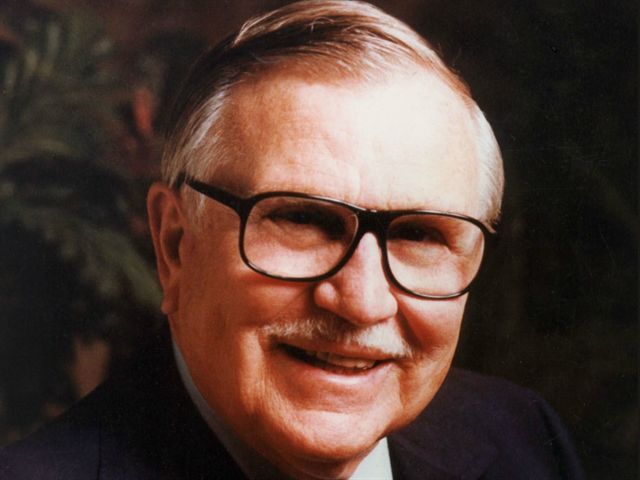
John Vernon McGeewas born in Hillsboro, Texas, in 1904. Dr. McGee remarked, "When I was born and the doctor gave me the customary whack, my mother said that I let out a yell that could be heard on all four borders of Texas!" His Creator well knew that he would need a powerful voice to deliver a powerful message.
After completing his education (including a Th.M. and Th.D. from Dallas Theological Seminary), he and his wife came west, settling in Pasadena, California. Dr. McGee's greatest pastorate was at the historic Church of the Open Door in downtown Los Angeles, where he served from 1949 to 1970.
He began teaching Thru the Bible in 1967. After retiring from the pastorate, he set up radio headquarters in Pasadena, and the radio ministry expanded rapidly. Listeners never seem to tire of Dr. J. Vernon McGee's unique brand of rubber-meets-the-road teaching, or his passion for teaching the whole Word of God.
On the morning of December 1, 1988, Dr. McGee fell asleep in his chair and quietly passed into the presence of his Savior.
Contact Thru the Bible with Dr. J. Vernon McGee
Mailing Address
Thru the Bible, Inc.
P.O. Box 7100
Pasadena, CA 91109
In Canada:
Box 25325,
London, Ontario
N6C 6B1
Phone Number
(626) 795-4145 or
(800) 65-BIBLE (24253)


